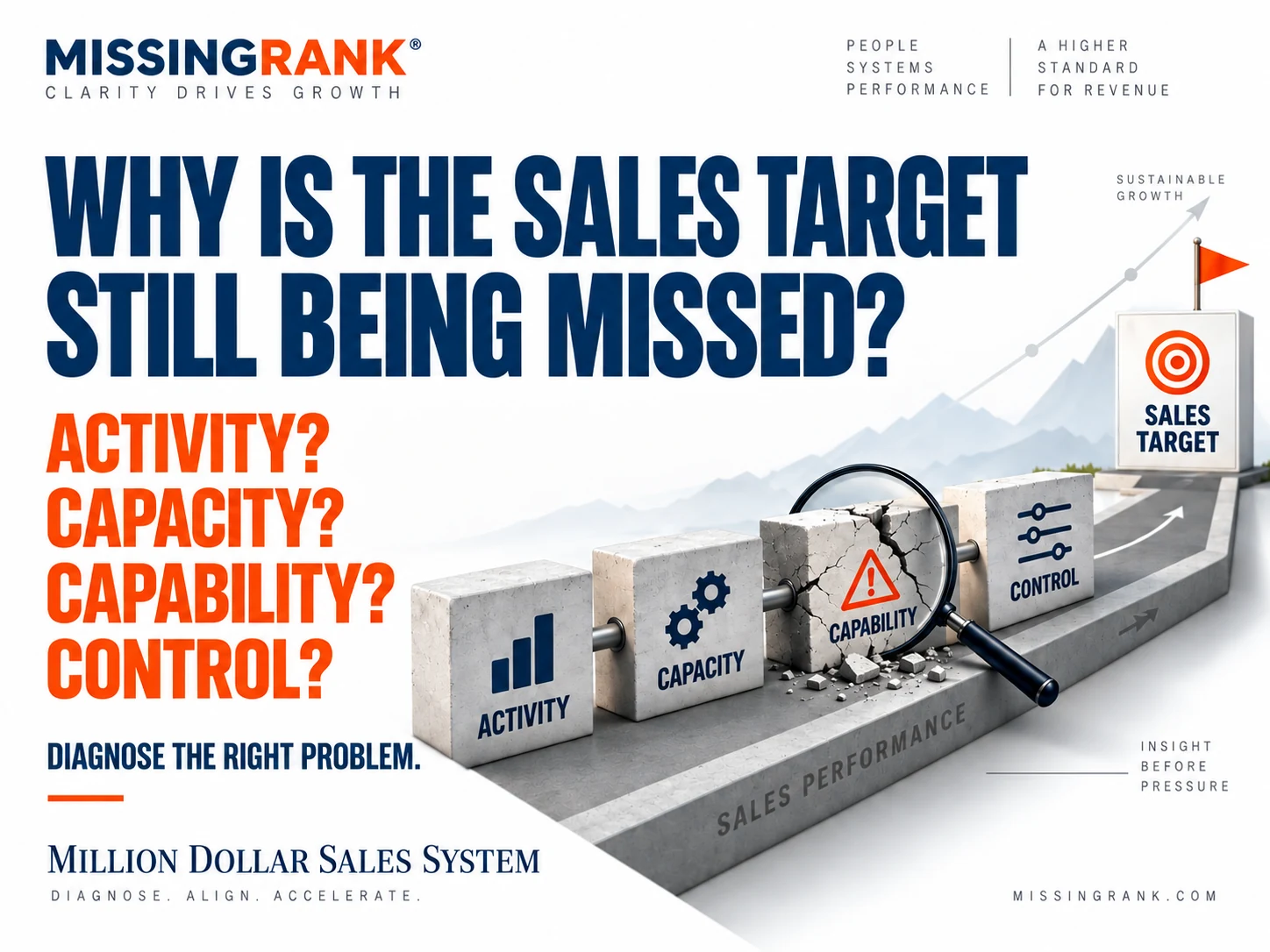
Your sales team is working hard. The target is still being missed.
The natural reaction is often: push harder, recruit more people, or arrange more training.
But these actions solve different problems.
If management diagnoses the wrong problem, even a well-executed solution can produce very little improvement.
The better question is:
Is the performance problem Activity, Capacity, Capability, or Management Control?
This is one of the diagnostic principles behind the Million Dollar Sales System (MDSS).
Before Diagnosing the Team, Confirm the Target
First, make sure the required outcome is clear.
What result is required?
By when?
What exactly counts as a completed sale or production?
Who owns the result?
Once the outcome is properly defined, management can investigate where the operating system is breaking down.
1. Activity Problem — Are We Doing Enough of the Required Work?
An Activity problem exists when the team is not completing enough of the activity required to support the target.
Depending on the sales model, this may include:
- prospecting;
- calls or lead contacts;
- appointments;
- sales conversations;
- follow-ups;
- or other defined commercial activity.
The key comparison is:
Required Activity vs. Actual Activity.
If the required level is 50 meaningful contacts and only 28 are being completed, the immediate problem is not closing skill. The required activity is not reaching the operating standard.
Management response: restore the missing activity before assuming the team needs more training or more people.
2. Capacity Problem — Do We Have Enough Productive People to Carry the Workload?
A Capacity problem is different.
The salespeople may be working at an acceptable activity level, but the organisation may simply not have enough productive sales capacity to carry the workload required by the target.
Do not confuse:
Headcount with productive capacity.
Ten people on the payroll do not automatically equal ten fully productive salespeople.
Some may be:
- new;
- inactive;
- still developing;
- inconsistent;
- or operating below the defined productive standard.
Management response: calculate the productive-capacity gap, restore recoverable capacity where possible, and recruit only for the remaining gap.
3. Capability Problem — Can the People Perform the Required Work Effectively?
Now assume activity is sufficient and enough productive people are available.
The next question is:
Can they perform the required work at the required standard?
A salesperson may complete enough meetings but convert too few. Another may struggle with qualification. Another may fail during the sales conversation, follow-up, objection handling, or another critical stage.
That is a Capability problem.
Management response: identify the specific observable capability gap and provide the appropriate training, coaching, practice, observation, feedback, and correction.
Generic training should not be prescribed simply because results are low.
4. Management Control Problem — Can Management See and Correct the Problem Early Enough?
This is the problem many organisations overlook.
The team may have people. Activity may be happening. Skills may exist.
But management still lacks control.
Ask:
- Are required standards clearly defined?
- Is actual performance being recorded?
- Can managers see variance early?
- Are pipeline movements visible?
- Is someone responsible for corrective action?
- Is correction followed through?
- Are daily, weekly, and monthly reviews actually changing performance?
If management discovers the shortfall only after month-end, the information may be accurate but commercially late.
Management response: install the visibility, review, corrective-action, ownership, and operating rhythm required to manage performance while there is still time to influence it.
The Mistake: Giving Every Problem the Same Solution
Consider four teams that are all missing target:
- Team A: not enough required activity;
- Team B: not enough productive sales capacity;
- Team C: enough activity, but weak capability at a critical conversion stage;
- Team D: capable people and activity exist, but management cannot see and correct variance early enough.
The revenue result may look similar.
The corrective action should not.
More recruitment will not automatically repair weak capability.
Training will not solve insufficient capacity.
More pressure will not repair poor management control.
And stronger management reporting cannot compensate for activity that never happened.
The MDSS Practical Solution: Diagnose Before You Prescribe
Million Dollar Sales System uses the Five MDSS Diagnostic Gaps:
Outcome → Activity → Capacity → Capability → Control
Their purpose is straightforward:
Find where performance is breaking down.
Repair the right system.
Restore management control.
Before ordering more calls, more recruitment, more training, or more pressure, identify which gap the evidence actually supports.
A Five-Minute Management Check
Ask these questions in order:
- Outcome: Is the required result precisely defined?
- Activity: Is enough required activity actually happening?
- Capacity: Do we have enough productive sales capacity to carry the workload?
- Capability: Can the people execute the required stages effectively?
- Control: Can management see variance, assign corrective action, and follow through early enough?
Do not move immediately to your favourite solution.
Follow the evidence.
Stop Managing the Target Alone
A missed target is an outcome.
The management opportunity is to discover which part of the system is restricting that outcome.
That is the difference between reacting to poor sales performance and managing it.
If you want to understand the operating logic behind the Million Dollar Sales System, read the free chapters:
Read the Free Chapters of Million Dollar Sales System →
Question for sales leaders and HR/L&D professionals:
When performance drops in your organisation, which problem is hardest to diagnose correctly:
Activity, Capacity, Capability, or Management Control?