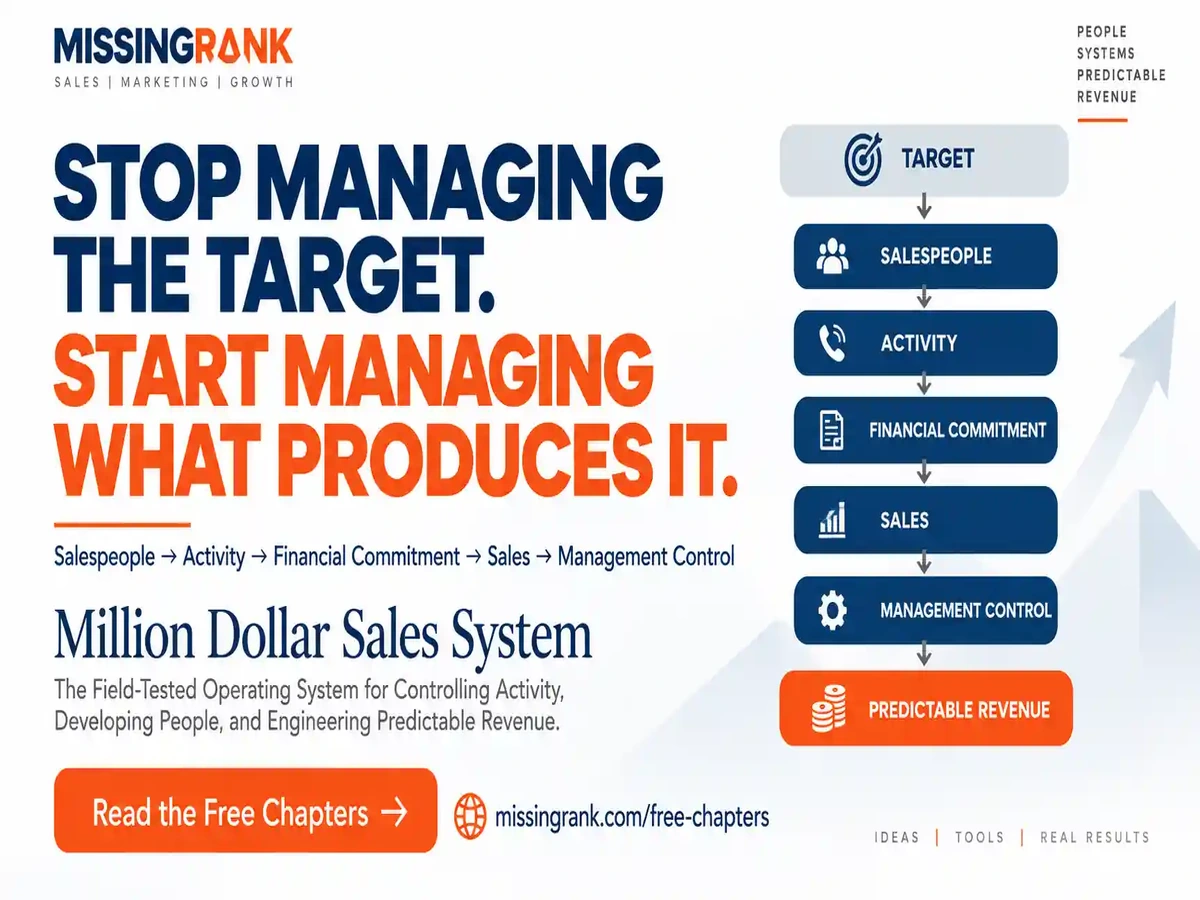
Million Dollar Sales System: From Target to Predictable Revenue
Most sales organizations begin with a number.
AED 1 million.
AED 5 million.
AED 10 million.
The target is announced. The team is informed. Managers distribute the number. Then pressure begins.
More calls. More meetings. More recruitment. More follow-up. More coaching. More training.
But one management question is often left unanswered:
What operating system must exist underneath the target for the result to become achievable?
That is the central problem addressed by the Million Dollar Sales System — MDSS.
A sales target is an outcome. It is not yet an operating plan.
The Five Controllable Areas Behind Revenue
MDSS converts the target into a connected management system built around five controllable areas:
Salespeople → Activity → Financial Commitment → Sales → Management Control
Revenue is the result produced when these systems work together.
1. Salespeople: Do You Have Enough Productive Capacity?
The first mistake is to confuse headcount with productive capacity.
Ten people on a sales roster do not automatically provide the capacity of ten productive salespeople.
Some may be fully productive. Some may be partially productive. Some may be under restoration. Some may need replacement. Some may simply not have enough evidence yet to classify correctly.
How much dependable productive capacity does the business actually have?
This matters because recruitment should not begin from instinct, vacancies, or a round-number hiring target.
It should begin from the workload required by the operating plan.
Roster size ≠ productive salesforce.
The salesforce must be capable of carrying the workload required by the target.
2. Activity: What Work Must Actually Happen?
Once the target is clear, management must reverse-engineer the work behind it.
Production Target: AED 1,000,000
Average Production per Sale: AED 20,000
AED 1,000,000 ÷ AED 20,000 = 50 Sales required
If one Sale requires five Financial Commitments:
50 Sales require 250 Financial Commitments
If one Financial Commitment requires three Meetings:
250 Financial Commitments require 750 Meetings
If one productive salesperson can complete 50 Meetings during the planning period:
750 ÷ 50 = 15 productive salespeople required
The target has now been translated from a financial ambition into an operating requirement.
Calculate backward. Reconcile forward.
That is fundamentally different from simply saying: "Here is the target. Go achieve it."
3. Financial Commitment: Is Activity Creating Commercial Movement?
A team can be extremely busy and still produce weak results.
Calls may be happening. Appointments may be booked. Meetings may be completed. Yet the pipeline may still fail to progress.
This is why MDSS distinguishes:
Activity Volume
from
Activity Quality
Is legitimate activity progressing far enough toward Financial Commitment?
Consider two salespeople.
Both complete 50 Meetings.
Salesperson A generates 20 Financial Commitments.
Salesperson B generates 10.
The Meeting activity is identical. The commercial movement is not.
That is why simply asking for more activity can be the wrong management response.
Activity Gap ≠ Conversion Gap.
Conversion tells management where to investigate. It does not explain the cause by itself.
The purpose of measurement is therefore not merely to identify a low number. It is to locate where the commercial process begins to weaken.
4. Sales: Does Commitment Actually Become Completed Business?
Financial Commitment is important. But it is not yet completed revenue.
A full pipeline can create false confidence.
Salespeople may say: "The business is coming."
Management may see large pipeline values and assume future Production is secure. But MDSS asks:
What is actually moving?
A Pipeline may contain many valid opportunities while completed Sales remain weak.
Cases may be:
- stalled;
- awaiting documentation;
- missing follow-up;
- without ownership;
- sitting beyond the expected stage time;
- lost;
- duplicated;
- incorrectly recorded.
Pipeline size ≠ Pipeline movement.
Pipeline value ≠ completed Production.
Management therefore needs visibility into:
Case → Stage → Owner → Next Action → Due Date → Evidence → Movement
A salesperson saying, "I called the customer again", does not automatically mean progress occurred.
What changed?
That is how MDSS moves from reporting activity to controlling commercial movement.
5. Management Control: Can the Manager Detect, Correct and Verify?
The final system governs all the others.
Management Control answers:
What happens when performance deviates from the required standard?
A weak management system notices the final number too late.
The target is missed. Then management reacts.
A stronger system identifies deviation earlier and asks:
- What was required?
- What actually happened?
- Where did the variance first appear?
- What does the evidence prove?
- What does it not prove?
- What is the main limiting factor?
- What corrective action fits that cause?
- Who owns the action?
- When will it be reviewed?
- What measure should improve if the diagnosis is correct?
This is where MDSS separates itself from generic sales training.
Performance Gap ≠ Training Need.
A performance gap may require:
- activity restoration;
- coaching;
- training;
- accountability correction;
- workload correction;
- process support;
- resource action;
- escalation;
- or more evidence before deciding.
When coaching is appropriate, the manager should not coach everyone the same way.
The correction must be based on observed execution, not generic advice.
The Complete MDSS Operating Logic
Salespeople
Do we have sufficient productive capacity?
↓
Activity
Is enough of the required controllable work happening?
↓
Financial Commitment
Is activity progressing into genuine commercial commitment?
↓
Sales
Are commitments moving into completed business?
↓
Management Control
Can management detect deviation, diagnose correctly, assign correction, and verify improvement?
↓
Predictable Revenue
This is why MDSS is not simply a sales-training program.
It is a sales-management operating system.
Why Most Sales Problems Are Misdiagnosed
Consider these common reactions.
Production is low.
Management says: Recruit more people.
But the existing capacity may already be underutilized.
Activity is low.
Management says: Send the salesperson for training.
But the actual problem may be prospect supply or workload.
Activity is high.
Management says: Increase activity again.
But Conversion may be the true weakness.
Pipeline is full.
Management says: Revenue is coming.
But the pipeline may be stalled.
Conversion is low.
Management says: Coach everyone.
But each salesperson may have a different execution problem.
The repeated management failure is the same: Solution selected before cause is established.
MDSS replaces that pattern with:
Measure → Investigate → Diagnose → Correct → Verify
The Management Principle Behind MDSS
A target tells management: What must be achieved.
The operating system tells management: What must happen for it to be achieved.
Management control tells leadership: What to correct when actual execution differs from requirement.
That is the difference between:
Managing the target
and
Managing what produces the target.
Final Thought
Weak management asks:
"Why did we miss the number?"
Better management asks:
"Which part of the sales process is below requirement?"
Strong management asks:
"What system produced the current result, where is that system constrained, what evidence proves it, and what management action will correct it?"
That is the operating logic behind the Million Dollar Sales System.
Salespeople → Activity → Financial Commitment → Sales → Management Control → Predictable Revenue
Read the Million Dollar Sales System — Free Chapters
Explore the management principles, frameworks and operating logic behind MDSS.
Read the Free Chapters →https://www.missingrank.com/free-chapters