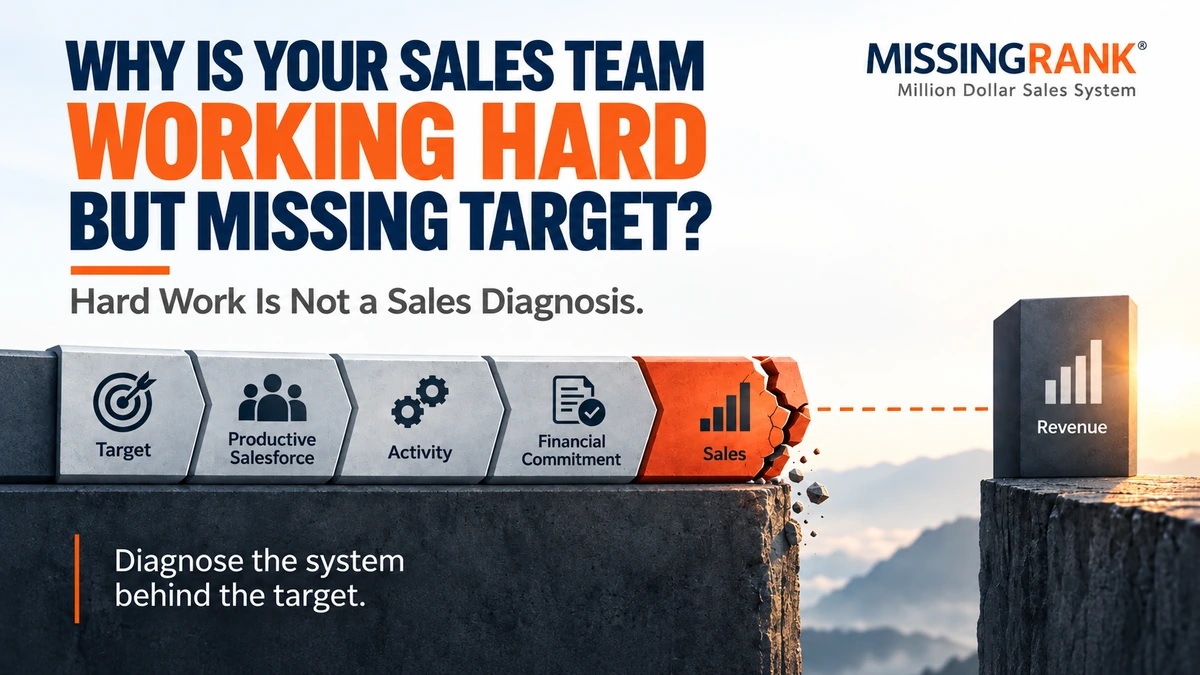
A sales team can be busy all month and still miss its target.
Calls are being made. Meetings are happening. Proposals are being sent. Managers are following up.
Yet revenue remains below expectation.
The immediate reaction is often: “We need more activity.”
Sometimes that is correct. Often, it is not.
The more useful management question is: Where is the sales system failing to convert effort into revenue?
Hard Work Is Not a Sales Diagnosis
Sales results are produced through a sequence of connected conditions and actions.
In the Million Dollar Sales System (MDSS), the commercial sequence is:
Target → Productive Salesforce → Required Activity → Financial Commitment → Follow-up & Objection Handling → Sales → Revenue
A weakness anywhere in that sequence can affect the final result.
A team may be working hard but still have:
- Too few genuinely productive salespeople.
- Insufficient activity relative to the target.
- Plenty of activity but poor conversion.
- Sales conversations that fail to produce financial commitment.
- Commitments that stall during follow-up.
- Weak objection handling.
- Sales that are not completed properly.
- Management intervention that happens too late.
These are different problems. They should not receive the same management response.
Start With the Target — Then Work Backwards
Suppose a business wants AED 1 million in monthly revenue.
That number alone does not tell a sales manager what must happen tomorrow.
Management needs to reverse-engineer the target into operating requirements.
- How many sales are required?
- How many financial commitments must produce those sales?
- How many qualified sales conversations are required to generate those commitments?
- How much activity must each productive salesperson perform?
- How many productive salespeople are actually required?
Now the target begins to become manageable.
Instead of asking, “Why aren't people working harder?” management can ask:
“Which requirement is currently below the level necessary to produce the target?”
That is a much more useful question.
Busy Teams Can Still Have a Capacity Problem
Another common mistake is assuming that headcount equals sales capacity. It does not.
Ten people on the sales team do not necessarily represent ten productive salespeople.
Some may be new. Some may be inactive. Some may lack capability. Others may be producing activity without sufficient commercial movement.
Management therefore needs to distinguish between people employed and productive sales capacity available.
If the target requires eight productive salespeople but only five are currently capable of producing at the required level, demanding more effort from those five may not solve the underlying problem.
More Activity Is Not Always the Answer
Activity matters enormously. But activity must be connected to conversion.
If calls increase while sales conversations do not, the problem may be activity quality.
If conversations increase while financial commitments remain weak, the problem has moved further down the sales process.
If commitments are strong but completed sales remain low, management should examine follow-up, objections, documentation, payment, or closing.
This is why simply telling the team to “make more calls” can create more activity without fixing the revenue problem.
Manage the System Behind the Target
A revenue target is an outcome.
Management cannot directly control the outcome, but it can control many of the conditions that produce it.
That means making the required activity visible, measuring conversion, identifying capacity and capability gaps, reviewing commercial movement, and taking corrective action before the month is lost.
Stop managing the target alone. Manage the system behind the target.
When a sales team is working hard but still missing its number, the first intervention should not automatically be pressure.
It should be diagnosis.
Find where performance stopped converting. Then correct the right problem.
Is Your Sales Target Breaking Somewhere Inside the System?
If your team is active but revenue remains below target, MISSINGRANK can help identify whether the constraint sits in productive capacity, activity, conversion, financial commitment, follow-up, closing, or management control.
Start with a complimentary 30-minute sales-performance diagnostic session.
Or explore the Million Dollar Sales System and read the free chapters.